Some destinations announce themselves loudly. Others remain quiet enough that people discover them almost by accident.
Shelter Cove, along California’s Lost Coast, belongs to the second kind of place.
Tucked between the steep slopes of the King Range and the open Pacific Ocean, this small coastal community sits beside one of the most untouched stretches of shoreline in the state. No coastal highway runs through this landscape. The mountains proved too steep and unstable for the road builders, leaving the coast largely as it had been for generations.
That accident of geography preserved something rare in California: a place where wilderness still shapes the experience more than development.
People who eventually find their way here are often drawn by similar instincts. They are curious about quiet landscapes. They prefer authentic places over curated destinations. They enjoy discovering wild corners of the map before they become widely known.
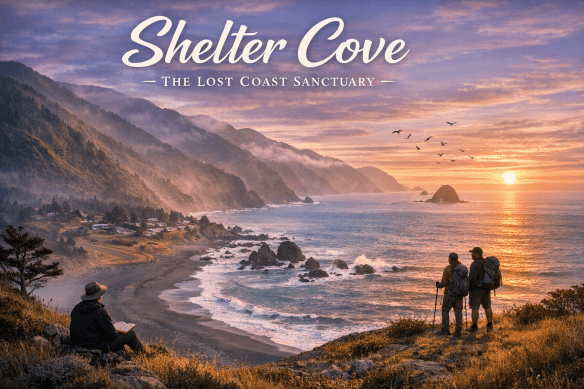
For those travelers, Shelter Cove can feel less like a tourist stop and more like a discovery — a place where mountains descend into the Pacific, fog moves slowly along the cliffs, and the rhythm of life follows weather, tides, and light rather than schedules.
That is the quiet allure of the Lost Coast.
Explore This Page
- An Audio Overview of this Secret Sanctuary of The Lost Coast’s Shelter Cove
- Why Shelter Cove Feels Different
- A Place for People Drawn to Quiet Depth
- Quiet Practices That Naturally Belong Here
- A Landscape Protected by Geography
- The Lost Coast as Living Wilderness
- Idyllic, Spiritual, and Restorative
- What You Feel Here
- For Those Who Feel Drawn to Wild Edges
- Appendix: See Also
- Deep Dive on: Shelter Cove: A Sanctuary on California’s Lost Coast
An Audio Overview of this Secret Sanctuary of The Lost Coast’s Shelter Cove
Note, this comes from a variety of sources and all the details have not been verifed.
Why Shelter Cove Feels Different
Some destinations impress. Shelter Cove reorients.
The road in winds through forest and mountain before suddenly releasing you to open ocean, black sand, sea air, and cliffs. The transition matters. You do not drift into Shelter Cove by accident. You arrive with intention, and that very arrival begins changing the pace of attention.
What makes the place memorable is not only its scenery, though the scenery is striking. It is the convergence of forces. The Pacific feels raw and close. The mountains rise abruptly, not as backdrop but as presence. Very old and massive redwoods stand inland in cool, filtered quiet. Fog moves through the landscape like weather with memory. At night, darkness returns in full, and with it, stars.
This is why Shelter Cove can feel both idyllic and spiritual.
It is idyllic in the deepest sense, not because it is polished, but because it remains close to what it is. It is spiritual not because anyone tells you what to believe there, but because the scale, silence, and wildness invite reflection without demanding it.
A Place for People Drawn to Quiet Depth
Shelter Cove tends to resonate with people who are hungry for something increasingly hard to find. Not entertainment. Not luxury branding. Not a checklist. Something quieter.
Writers, artists, hikers, pilots, photographers, and reflective travelers often feel this pull first. So do people who have simply had enough of noise. Shelter Cove offers an uncommon combination: physical beauty, sensory quiet, and the humbling feeling of being somewhere that does not exist to perform for you.
That is part of its healing quality.
There is room here to walk without agenda. To watch changing light over the Pacific. To sit above the cliffs and let the horizon widen the mind. To move from black sand beaches to forest trails and feel, within the span of a day, how varied and alive this coastal wilderness really is.
Quiet Practices That Naturally Belong Here
The atmosphere of Shelter Cove naturally supports practices that thrive in stillness and open space. Visitors sometimes greet the morning with quiet meditation above the cliffs or simple stretching as the first light rises over the Pacific.
Others bring practices such as yoga, tai chi, or qi gong to the grassy bluffs where the sound of waves becomes a steady rhythm. Artists sketch the coastline. Writers sit with notebooks as fog drifts across the horizon. Photographers wait for the slow transformation of light on water and stone.
For many people, the most restorative experience is even simpler: walking the beaches, breathing the ocean air, watching weather move across the Pacific, and allowing the mind to slow down.
Shelter Cove does not organize these moments or package them into programs. The landscape itself creates the conditions. The cliffs, the sea air, the vast horizon, and the quiet invite reflection without instruction.
Some visitors arrive seeking adventure along the Lost Coast Trail. Others come for something quieter: decompression, creative thinking, personal reset, or the rare opportunity to step away from constant noise and reconnect with something deeper.
A Landscape Protected by Geography
The Lost Coast earned its name because early road builders found the terrain too steep and unstable for California’s coastal highway. When planners attempted to extend Highway 1 northward, the mountains of the King Range proved too rugged and landslide-prone to support the route. Rather than forcing a road through the terrain, the highway was pushed inland.
That decision preserved something rare. Much of this coastline remained undeveloped, leaving one of the longest stretches of wild Pacific shoreline in California largely intact. Today large portions of the region are protected within the King Range National Conservation Area, helping preserve coastal ecosystems, wildlife habitat, and the dramatic mountains-to-ocean landscape that defines the Lost Coast.
Wildlife thrives in this relatively undisturbed environment. Offshore waters support sea lions and migrating whales, while Roosevelt elk, black-tailed deer, seabirds, and bald eagles move through the coastal hills and beaches. The region’s famous black sand beaches and rugged cliffs reflect the area’s geologic past, where tectonic forces and ancient volcanic material shaped the shoreline.
The Lost Coast as Living Wilderness
Shelter Cove is one of the best gateways into the Lost Coast, a region known for dramatic cliffs, remote beaches, black sand, wildlife, and long stretches with little or no cell service. This is part of the appeal. In a hyperconnected age, the Lost Coast still offers a silent haven where solitude is not manufactured but natural.
The area’s best-known adventure is the Lost Coast Trail, a route that has become nationally recognized for its beauty and seriousness. It is not a casual beach walk. Hikers plan around tides, weather, and access. That reality reinforces the central truth of the place: nature still sets the terms here.
Yet Shelter Cove is more than a trailhead. It is also a community at the edge of a wilderness. It is where rugged coast, small-town warmth, and elemental beauty coexist. A visitor can spend the day hiking, tidepooling, beachcombing, fishing, sketching, or simply standing still. The activity matters less than the atmosphere in which it happens.
Idyllic, Spiritual, and Restorative
If one word is not enough, Shelter Cove may be best described as an idyllic, spiritual, and restorative destination.
Idyllic, because it still feels like a hidden corner of California where beauty has not been overrun by spectacle.
Spiritual, because the land itself creates the conditions for inward quiet, awe, humility, and perspective.
Restorative, because remoteness, dark skies, silence, and immersion in powerful nature often return people to themselves.
A fourth word also belongs here: authentic.
Shelter Cove has not been over-edited into an idea. Its appeal comes from what it has not become.
What You Feel Here
Many places tell you what they are supposed to mean. Shelter Cove leaves more room for discovery.
Some people feel wonder first. Others feel stillness. Others feel a subtle release, as if the nervous system recognizes something before the mind catches up. The black sand, the sea stacks, the changing weather, the wildlife at dusk, the redwoods inland, the cliffs above the Pacific, and the long, dark nights all work together to create a destination that is as much about inner experience as outer scenery.
That is why Shelter Cove lingers.
It is not only a place to visit. It is a place to remember.
For Those Who Feel Drawn to Wild Edges
Shelter Cove and the Lost Coast will not call to everyone, and that is part of their integrity. They tend to draw people who value remoteness, humility, and beauty that has not been flattened into sameness.
For those people, this little-known corner of California can feel like a true coastal sanctuary. Not because it was designed to be one, but because it still allows the mountains, the ocean, the redwoods, the weather, and the silence to lead.
That may be the deepest invitation Shelter Cove offers.
Not escape.
Reconnection.
Appendix: See Also
SFGATE: I accidentally found California’s best coastal hike
This article helps capture the sheer remoteness and emotional impact of the Lost Coast. It describes dramatic cliffs, profound solitude, black sand, Roosevelt elk, and towering redwoods in language that supports Shelter Cove’s identity as a place of true wilderness rather than ordinary tourism. It is especially useful for reinforcing how unusual it is to find such beauty with so few people around. The article also helps position the region as both humbling and restorative.
Travel + Leisure: This Remote U.S. Trail Has Black-sand Beaches, Elk Herds, and Is a Silent Haven With No Cell Service or Crowds
This piece is valuable because it frames the Lost Coast as a nationally significant destination for travelers seeking quiet, remoteness, and unspoiled nature. The emphasis on black-sand beaches, elk, silence, and lack of crowds aligns closely with Shelter Cove’s deeper appeal. It helps validate that this is not only a local secret, but a place increasingly recognized for the kind of restorative experience it offers. The language around silence and remoteness is especially relevant.
FLYING Magazine: Shelter Cove Offers an Idyllic Airport Getaway
This article is useful because it explicitly calls Shelter Cove idyllic while also emphasizing how remote and effortful it is to reach. That combination is central to the place’s identity. The piece also highlights the unusual presence of a small airport beside the Pacific, which adds character without diminishing the area’s wilderness feel. It can help broaden the page’s appeal to adventurous travelers, pilots, and people drawn to uncommon gateways.
Inn of the Lost Coast
Even without centering lodging in the main page, this site is useful for the language it uses around panoramic ocean views, the pace of retreat, and Shelter Cove’s direct relationship with the Pacific. It reflects how the area is already being perceived by visitors seeking rest, beauty, and decompression. For inspiration, it is most helpful as evidence that Shelter Cove already carries a retreat-like identity in the minds of many travelers. That existing perception can be elevated into a deeper place-based narrative.
Gyppo Ale Mill
Gyppo Ale Mill adds something important to the picture of Shelter Cove: local character. Its language around being in one of California’s most remote settings helps reinforce the region’s defining remoteness, while also showing that the community has warmth, humor, and gathering places. This matters because Shelter Cove is not only solitude. It is also a lived-in, human place at the edge of wild nature. That balance strengthens the destination story.
Travellers Elixir: Beautiful California Beaches / Black Sand Beaches in California
This source is helpful because it reinforces the distinctiveness of Shelter Cove’s black sand beaches within a broader California travel context. It can support phrasing that highlights how visually and geologically unusual the coastline feels compared with more familiar beach destinations. While it is lighter than the major travel publications, it still contributes to the sense that Shelter Cove offers a coastal experience unlike the polished, crowded norm. That contrast supports the page’s positioning well.
Shelter Cove House: Why Visit Shelter Cove, California?
This local page is useful because it frames Shelter Cove as one of the last truly untouched coastal towns in California. That language aligns closely with the positioning of Shelter Cove as idyllic, restorative, and authentic. It also helps confirm that peace-seekers, hikers, and nature lovers are already part of the area’s natural audience. Used carefully, it supports local authenticity without shifting the page into property marketing.
Deep Dive on: Shelter Cove: A Sanctuary on California’s Lost Coast
A Research Report on Geography, Experience, and the Quiet Power of Place
Along a coastline famous for its dramatic cliffs and near-total absence of development, Shelter Cove stands as one of California’s rarest destinations: a place where wilderness still shapes human experience more than human intention. As the source document notes, “Some destinations announce themselves loudly. Others remain quiet enough that people discover them almost by accident.” Shelter Cove belongs firmly to the latter category.
This report examines Shelter Cove as a sanctuary—geographically, emotionally, and experientially—drawing on the themes and language of the attached document Lost Coast Sanctuary for Reflection, Wilderness, and Renewal. The analysis focuses on five dimensions:
- The role of geography in preserving the area’s wild character
- The types of visitors drawn to Shelter Cove
- The quiet practices the environment naturally supports
- The emotional and spiritual resonance of the place
- The contrast between Shelter Cove and more commercialized coastal destinations
1. Geography as Guardian: How the Land Preserved the Wilderness
Shelter Cove exists as it does because the land refused to be tamed. The Lost Coast earned its name when early road builders discovered the terrain was “too steep and unstable for California’s coastal highway.” As a result, Highway 1 was forced inland, leaving this stretch of coast undeveloped and largely untouched.
The document emphasizes that this accident of geography “preserved something rare in California: a place where wilderness still shapes the experience more than development.” The steep King Range mountains descend directly into the Pacific, creating a dramatic mountains-to-ocean interface that is both visually striking and logistically isolating.
This isolation has ecological consequences as well. The coastline remains a thriving habitat where “sea lions and migrating whales” move offshore and “Roosevelt elk, black-tailed deer, seabirds, and bald eagles” inhabit the surrounding land. The region’s volcanic and tectonic history further shapes its black sand beaches and rugged cliffs.
In short, geography is not a backdrop here—it is the architect of the sanctuary.
2. Who Comes Here: Visitors Drawn to Quiet Depth
Shelter Cove attracts a particular kind of traveler. The document describes them as people “curious about quiet landscapes” who “prefer authentic places over curated destinations.” These are not checklist tourists or luxury seekers. They are individuals hungry for something increasingly scarce: depth, quiet, and unmediated nature.
The text identifies several groups explicitly:
- Writers and artists
- Hikers and backpackers
- Pilots (drawn by the remote airstrip)
- Photographers
- Reflective travelers
- People who have simply had enough of noise
These visitors are not escaping life so much as seeking reconnection. As the document puts it, Shelter Cove offers “an uncommon kind of quiet” and “room to walk without agenda.”
Their motivations cluster around:
| Visitor Type | Motivations |
|---|---|
| Writers & Artists | Inspiration, solitude, sensory clarity |
| Hikers & Adventurers | Rugged terrain, Lost Coast Trail access |
| Reflective Travelers | Healing, decompression, perspective |
| Pilots | Remote landing experience, oceanfront runway |
| Photographers | Dramatic light, black sand, cliffs, wildlife |
Across all groups, the common thread is a desire for authenticity and depth.
3. Quiet Practices the Landscape Naturally Supports
Shelter Cove is not a programmed retreat center. It does not offer packaged wellness experiences or curated itineraries. Instead, the land itself creates the conditions for contemplative practice.
The document highlights that “the atmosphere of Shelter Cove naturally supports practices that thrive in stillness and open space.” These include:
- Meditation above the cliffs
- Yoga, tai chi, or qi gong on grassy bluffs
- Sketching or painting the coastline
- Writing in notebooks overlooking the Pacific
- Walking the black sand beaches
- Watching weather move across the ocean
- Breathing the sea air and letting the mind settle
The key insight is that these practices arise organically. “Shelter Cove does not organize these moments or package them into programs.” The sanctuary is emergent, not engineered.
4. Emotional and Spiritual Resonance
Shelter Cove’s impact is not merely scenic—it is psychological and spiritual. The document repeatedly emphasizes the place’s capacity to shift inner states:
- “Some destinations impress. Shelter Cove reorients.”
- “The Pacific feels raw and close.”
- “Darkness returns in full, and with it, stars.”
- “Some people feel wonder first. Others feel stillness.”
- “Others feel a subtle release, as if the nervous system recognizes something before the mind catches up.”
This language points to a deeper phenomenon: Shelter Cove functions as a nervous-system sanctuary. Its remoteness, silence, and elemental beauty create conditions for awe, humility, and perspective.
The document summarizes this resonance with three words—“idyllic, spiritual, and restorative”—and adds a fourth: authentic. The spirituality here is not doctrinal but experiential, arising from the land itself.
5. A Contrast to Commercialized Coastal Destinations
Shelter Cove stands apart from the typical California coastal experience. It is not polished, curated, or crowded. The document notes that it feels idyllic “not because it is polished, but because it remains close to what it is.”
Where many coastal towns have been shaped by tourism, Shelter Cove has been shaped by geography and restraint. It has:
- No major resorts
- No boardwalks
- No commercialized beachfront
- Limited cell service
- A small, lived-in community rather than a tourist economy
The contrast is stark: while other destinations tell visitors what they are supposed to feel, “Shelter Cove leaves more room for discovery.”
This difference is not a marketing angle—it is the essence of the place.
Conclusion
Shelter Cove is a sanctuary not by design but by nature. Its steep mountains, raw Pacific coastline, and geographic isolation have preserved a rare kind of coastal wilderness. The people who find their way here tend to be seekers of quiet depth—artists, hikers, reflective travelers, and those weary of noise.
The environment supports contemplative practices without orchestrating them, offering space for meditation, creativity, and renewal. Emotionally, Shelter Cove reorients rather than entertains, inviting awe, stillness, and reconnection.
In a state known for spectacle, Shelter Cove’s power lies in what it has not become. It remains, as the document beautifully states, “not escape. Reconnection.”
This is the quiet allure of the Lost Coast—and the enduring sanctuary of Shelter Cove.
 Shelter Cove House